
This Porsche Concept Celebrates 50 Years of the 917

The Porsche 917 won Le Mans outright in 1970 and ‘72, and dominated North America’s CanAm series in 1972 and ‘73. And this year it turns 50.
To celebrate its half-centenary, Porsche has done some things. First, it set about restoring the first-ever 917. Chassis number 001 was revealed at the 1969 Geneva Motor Show and used mostly as a “test and presentation vehicle”. In its life it went through many colour and spec changes, making its restoration especially challenging. It took a team of engineers and technicians over a year, using original parts and materials where possible, to return 001 to original condition.
It will form part of a special exhibition at Porsche’s museum in Germany, running from May to September. Ten of the 14 exhibits are actual 917s (with a combined power output of 7,795bhp), and one is the model pictured above. It’s a concept study produced by a “small number of designers and engineers” within the company as a homage to the 917’s first Le Mans victory.
Look closely and you’ll see it’s a bit rough around the edges – this is a full-scale model, nothing else, that’s supposed to give us an idea of what a modern-day 917 might look like. No plans to turn it into a real thing, which is a crying shame because it looks ace. Think Porsche ought to revive the 917 proper?
By: Tom Harrison, March 11, 2019
For more cars, visit: https://www.topgear.com/car-news/concept/porsche-concept-celebrates-50-years-917
Source: https://www.topgear.com/
McLaren Senna GTR Production Model Is Here To Rule The Track

Leave it to McLaren to take an already hardcore performance machine such as the Senna and turn it into something truly extreme. Unveiled a year ago as a concept, the Senna GTR is debuting today in its final, track-only form and with a production run limited to just 75 examples – all of which have long been sold, of course. Joining its road car counterpart and the Speedtail in the company’s Ultimate Series, the GTR follows other track machines carrying the fabled suffix such as the P1 GTR and the iconic F1 GTR.
A mind-blowing mélange of numbers, the new Senna GTR offers 814 horsepower and 590 pound-feet (800 Newton-meters) of torque from McLaren’s highest spec yet of the twin-turbo 4.0-liter V8 engine. To unlock an extra 25 hp over the road car, the engineers from Woking got rid of the secondary catalyst to reduce back pressure and they also fiddled with the engine control. By removing that catalyst, McLaren says the race car’s soundtrack is more aggressive when compared to the anything-but-normal Senna.
While the concept had the exhaust pipes on the sides, in front of the rear wheels, the production-spec Senna GTR uses a rear-exit exhaust in the same vein as the standard model. The side exhausts were undoubtedly cool, but McLaren explains they decided to move the pipes to the rear to guarantee the quickest and shortest route for the exhaust gases to get out. In turn, this reduces complexity and shaves off weight.
Speaking of which, the track beast tips the scales at only 1,188 kilograms (2,619 pounds) or 10 kg (22 lbs) less than the road car to achieve the best power-to-weight-ratio (685 hp / ton) ever of any car built by McLaren Automotive. Not only that, but changes to the body allow the Senna GTR to generate a whopping 1,000 kg of downforce or a full 200 kg more than the road version. The track car can achieve the same level of downforce as the standard Senna at a 15-percent lower speed as a result of the updated aero package.
Being built exclusively for the circuit, it comes as no surprise McLaren got rid of most creature comforts to shave off fat, but you still get air conditioning to keep you cool on a hot track day. Replacing the kit you’ll find in the road model are race car-specific goodies like a data logger and a pit radio, while a fire extinguishing system and pneumatic air jacks were added as well. Without the essential track equipment, the Senna GTR would’ve been even lighter.
All told, the Senna GTR is the quickest McLaren ever built outside of Formula 1.
By: Adrian Padeanu, March 8, 2019
Source: https://www.motor1.com/
The 2019 Geneva Auto Show’s Must-See Debuts and Wildest Concept Cars
Anyone who thinks that modern auto shows are dying a slow death—particularly after this year’s downright boring Detroit auto show—needs to fly themselves to Geneva, Switzerland, at take in that city’s international motor show. The 2019 Geneva show was huge, with an alluring mixture of new-car debuts, fanciful concept cars, and more low-volume supercars than you can shake financial crimes at.
Okay, so travel to Switzerland and accommodations in a city best known for having a lake and being a destination for banking and watch purchases isn’t cheap, nor is it likely to be quick or easy. That’s why we went, and while in Geneva not swimming in the lake, banking, or purchasing watches, we sorted through the auto show’s myriad vehicles to find the ten that matter most. Swipe through for the list, and be sure to see everything else from the show in our full-throated coverage.

Pronounced “toe-nah-lay,” this Tonale concept is Alfa Romeo’s vision for a new, smaller crossover destined to join its lineup beneath the compact Stelvio. You can tell from the Tonale—for the last time, it’s not “toenail”—that it is front-wheel drive–based, not rear-drive like the Stelvio or the Giulia sedan. Besides entering Alfa Romeo into the lucrative market segment that also includes subcompact luxury offerings such as the BMW X1, Mercedes-Benz GLA-class, and Lexus UX, the Tonale promises to offer a plug-in hybrid powertrain when it eventually goes on sale. That makes it Alfa Romeo’s first-ever hybrid model.

Among a flotilla of new supercars and supercar-like show cars Aston Martin debuted in Geneva, the Vanquish Vision concept rose above the rest. First off, this will be the tamest of the coming flood of mid-engine Aston Martins, which also includes the 003 and the Valkyrie, yet will still have a new V-6 engine and hybridization like those cars. Its focus on road performance, rather than all-out track acumen, means that its body is free from most of the wings, slats, slits, and other distractions on its more powerful siblings and thus is somewhat prettier. Either way, get ready, because Aston is taking the supercar fight to McLaren and Ferrari’s doorsteps.

Audi’s electric lineup continues to expand, at least if you count the volume of concept cars the automaker has unveiled in recent years. So far, only the e-tron has made it to market, but this smaller Q4 e-tron won’t be far behind. Promised for 2021, the eventual production Q4 e-tron likely will closely resemble this concept. It also is said to arrive with around 280 miles of driving range per charge from its 82-kWh battery pack, one drive motor per axle (providing all-wheel drive), and a bullseye on its tailgate from Tesla’s upcoming Model Y compact electric crossover.

This Is the AM-RB 003, Aston Martin’s Mid-Engine Hypercar
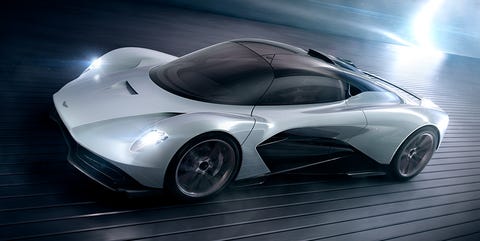
Aston Martin us has been teasing us for months about its upcoming mid-engine hypercar to follow the Valkyrie. Now, we finally get to see it in full. This is the AM-RB 003. Packing a mid-mounted turbocharged V-6 hybrid powertrain, it’s set to go into production in 2021 with a limited run of 500 units.
Aston Martin says the 003 is heavily influenced by the Valkyrie, using much of the same technology and fundamental design cues. The fascia and profile lines are similar, though the 003’s overall shape is less severe than the Valkyrie. “The design isn’t as extreme in some areas, but it pushes just as hard in others, and is even taking certain ideas and concepts a step further,” Miles Numberger, director of design, said in a press release.
The most interesting part has got to be the rear wing. It’s equipped with something called FlexFoil, a NASA-validated aerospace tech that promises leaps in aerodynamic performance. Here’s how Aston explains it:
The system allows for the car’s downforce to be changed without changing the physical angle of the entire element, resulting in a seamless design with high performance, improved efficiency and reduced wind noise. Turbulence and the associated drag increase found in current “state of the art” active wing designs is virtually eliminated too.
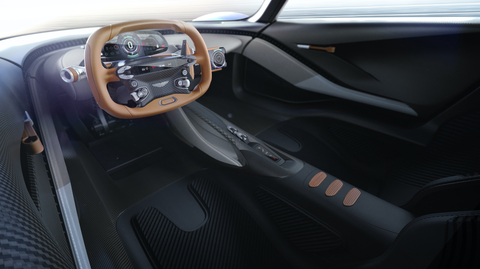
While the exterior is certainly a treat to look at, it’s inside the cockpit where the differences between this and the Valkyrie become clear. The 003’s passenger compartment is larger and more accommodating, with space behind the seats for luggage, a center console, and even a place to mount your phone on the dash (why doesn’t every car have this?). There’s also a racing-inspired steering wheel full of vehicle controls and a display screen in the hub. Also note the cool wing-shaped paddle shifters.
Aston Martin hasn’t disclosed many performance specs on this upcoming hypercar, but the automaker revealed that the new turbocharged V-6 was fully designed in-house. It will use Castrol’s Nexcel 90-second oil change system, which was first tested on the track-only Vulcan. The 003 will be the first production road car to use the system.
Expect to see the first 003s on the road in late 2021. But don’t expect it to keep the name—like the Valkyrie, the numerical designation is only for internal purposes, and a more memorable name will be revealed soon.
By: Brian Silvestro, March 5, 2019
For more cars, visit: https://www.roadandtrack.com/car-shows/geneva-auto-show/a26629949/aston-martin-am-rb-003-pictures-specs-price-hp/
Source: https://www.roadandtrack.com/
Bugatti La Voiture Noire Revealed As Most Expensive New Car of All Time
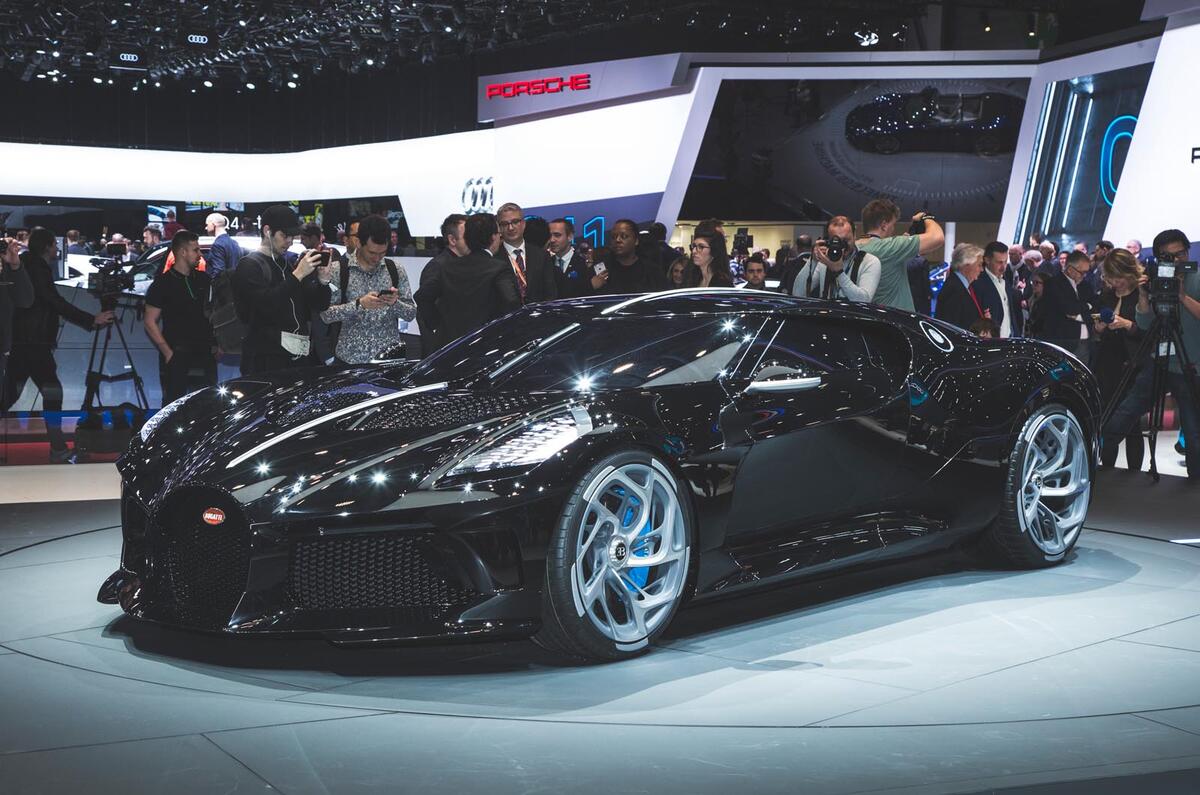
La Voiture Noire, priced at €11 million (around £9.45m) before taxes, has already been sold. If sold in the UK, the price would be some £11.3m including VAT.
La Voiture Noire, which arrives in Bugatti’s 110th anniversary year, features aggressive styling up front with a more pronounced grille than either the Veyron or Chiron, while the headlights recede back above the wheel arches rather than being placed horizontally above the bumper, which now juts out sharply.
While the styling isn’t entirely reminiscent of the smooth coupé contours and elongated bonnet of the original Atlantic, the most definitive stylistic aspect has been retained: the dorsal seam running up along the bonnet, between the windows and over the roof of the body (although the rivets have been left out).
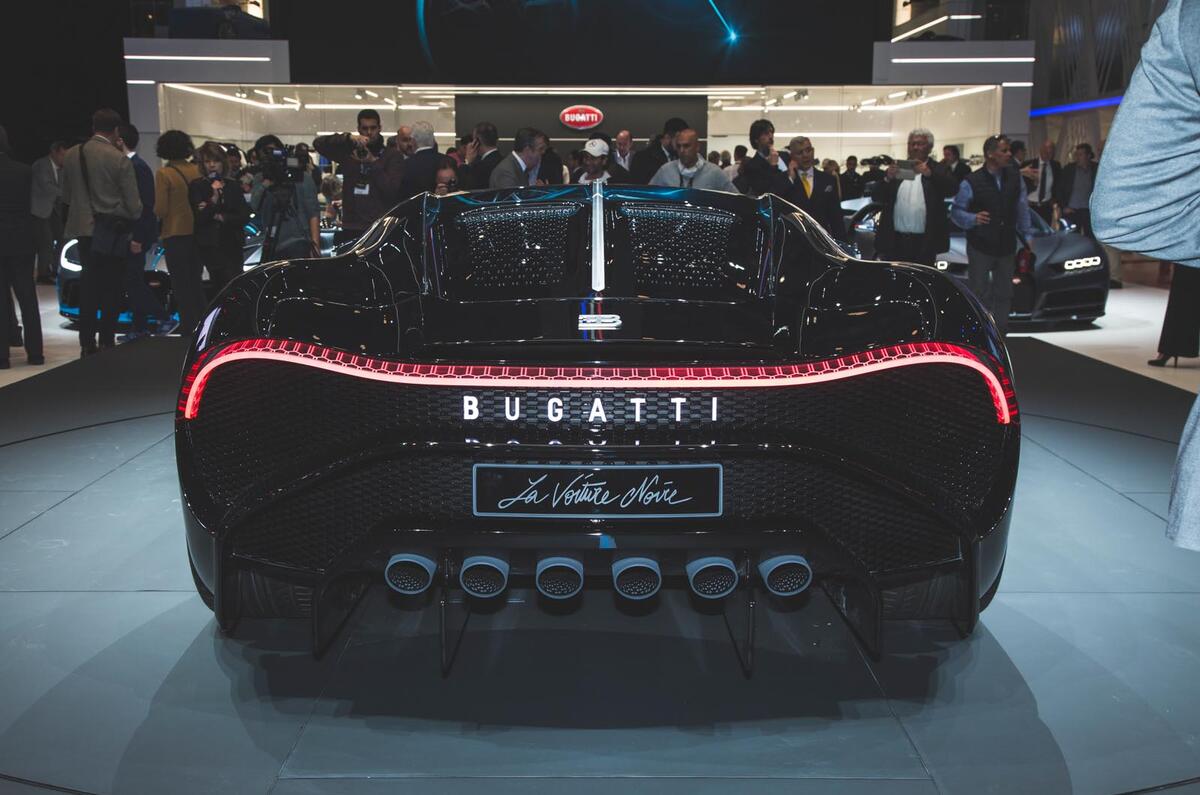
At the rear, a continuous rear light runs along a grille-like back end, McLaren P1 style, with the company name illuminated in white below. All this sits above a bespoke exhaust set-up comprising six separate pipes running away from the car’s 1479bhp 8.0-litre 16-cylinder engine. From the specs, it is likely to be the same engine used in the Chiron.
The car is based on the Chiron but the wheelbase has been lengthened slightly. Bugatti is understood to have made money on the project.
Bugatti has not named the buyer of the car, saying only that they are a ‘Bugatti enthusiast’. Stephan Winkelmann, Bugatti boss, said that Bugatti approached the customer direct about buying the car. The average Bugatti owner has around 30 cars, Winkelmann added, and the firm had a list of customers who may well be interested in products like the
“The true form of luxury is individuality,” said Winkelmann. “La Voiture Noire is now at the cutting edge of automobile production. It is a sculptural beauty with unique technology, the ideal grand tourer.”
“With La Voiture Noire, we are paying homage to our heritage and bringing speed, technology, luxury and aesthetics forward to a new era,” Winkelmann continued. “With our automotive haute couture, we have shown what Bugatti is capable of.”
By: Autocar, March 6, 2019
For more cars, visit: https://www.autocar.co.uk/car-news/motor-shows-geneva-motor-show/bugatti-la-voiture-noire-revealed-most-expensive-new-car-all
Source: https://www.autocar.co.uk/
Pininfarina Battista First Look: The Fully Electric, Nearly 1,900-HP Hypercar

It has 1,874 horsepower and 1,696 lb-ft of torque. It’ll hit 60 mph in 1.9 seconds, 100 mph in 4.3 seconds, and 186 mph in 11.8 seconds. Quarter mile? Gone in 9.1 seconds. Top speed? An autobahn-busting 218 mph. And there’s not a single turbocharger or camshaft or piston to be found. Welcome to the shocking future of the hypercar. Welcome to the Pininfarina Battista, one of the star cars of this year’s Geneva auto show.
The name is steeped in history. Battista ‘Pinin’ Farina founded his eponymous coachbuilding company in Turin, Italy, in 1930. The 1947 Cisitalia 202 coupe he designed was the first car to become part of the Museum of Modern Art’s permanent collection in New York. Pininfarina has also designed and built cars for Ferrari, as well as Alfa Romeo, Peugeot, and Cadillac (remember the Allante?), among others. But the Battista is a digital-age, crowd source-era hypercar, combining traditional notions of Italian design and craftsmanship with financial and technological resources that simply weren’t available 10 years ago.
Pininfarina SpA, which will build the Battista in Italy, is today majority owned by Indian automaker Mahindra, best known in the U.S. for its range of tractors and the Roxor off-roader, an ancient CJ Jeepclone it has built for decades. Automobili Pininfarina, which developed with the Battista concept and will sell the car, is 100 percent owned by Mahindra and staffed by highly experienced executives and engineers who have variously worked for Porsche and Pagani, Lamborghini and Bugatti, as well as Alfa Romeo and Audi.
Designed by Pininfarina SpA, the Battista at first glance looks vaguely like a reworked Ferrari 488. The Ferrari vibe is perhaps understandable, given the company’s long association with Maranello, even though the brief for the Battista came from Automobili Pininfarina design director Luca Borgogno, who worked at Lamborghini’s studio in Turin, most recently on the Urus SUV. Automobili Pininfarina insiders insist, however, the carbon -iber monocoque and body panels are all new and unique, a fact substantiated by doors that are cut into and are hinged at the roof, and swing forward and upward like those of a McLaren 720S.
The Koenigsegg Jesko Has 1600 HP and Promises a 300-MPH Top Speed

Koenigsegg will build 125 Jeskos in two variants. The track-focused version you see here is designed to produce more than 3000 lbs of downforce with Koenigsegg’s revolutionary Triplex suspension at front and rear. The low-drag Jesko version is a more road-friendly machine with a standard front suspension that leaves enough room in the front trunk to stow the removable targa roof.
And good news: No matter which spec you choose, the Jesko will be homologated worldwide—unlike some other extreme performance cars that aren’t road legal in certain nations.
We’ve talked about how special the Koenigsegg V-8 is before. For its last appearance before Koenigsegg goes electrified and camless across the board, the team has really gone the extra mile. You get 1280 horsepower on pump gas, or 1600 hp on E85. That’s partly because the Jesko’s V8 has a flat-plane crank that weighs just 27.5 lbs, milled from a solid steel billet in southern Sweden. To reduce thevibration you’d get from a flat-plane crank engine while as it approaches 8500rpm, Koenigsegg’s engine architect, Dr. Thomas Johansson, came up with new super-light connecting rods that are made from an ultra-strong Swedish steel alloy. Including the bolts, they weigh 19 pounds, which makes them exactly as light as the titanium rods of the Regera engine, but even stronger. Then, there’s the pistons.
They weigh 0.63 pounds each, with a ceramic-coated curved face that happens to be the strongest in production. As a result, they can take a crazy amount of pressure while allowing the long-stroke V8 to rev to 8500 rpm.
The Jesko may not use Koenigsegg’s camless Freevalve heads, but the ones it has are cast by Formula One suppliers Grainger and Worrall, with an extra “tumble” valve on the intake side to increase turbulence in the air-fuel mix.
Koenigsegg’s even-larger turbos would mean even more lag, but the Jesko’s engine features a clever system that uses pressurized air to spool up the compressor wheels and heat up the catalytic converters more quickly on cold start. In principle, the system is similar to one used on Volvo’s PowerPulse diesel, but Koenigsegg came up with a patent-pending turbo housing design, with pressurized air stored in a carbon fiber tank and blasting into the turbos at up to 290 psi. And with the catalytic converters reaching operating https://autoconcierge.net/wp-content/uploads/2019/01/Storage-2-copy-1.jpgerature in no time, this twin-turbo Koenigsegg V8 will comply with future global emission standards planned for as far away as 2026.
 More air demands more fuel, so the engine now sports three fuel injectors per cylinder. The third injector lives in the intake plenum, squirting in fuel directly above the intake runner for each cylinder. The extra blip of fuel also cools the cylinder, making for a cleaner combustion and less strain on the engine at the top of the power range.
Koenigsegg also threw in individual in-cylinder pressure sensors, a first for road cars. This allows the in-house-designed Engine Management System to monitor and control each cylinder at maximum efficiency. All this results in 1106 pound feet of torque to accompany your 1280 pump-gas horses.
If you thought the Regera’s direct-drive system was nuts, buckle up for what Koenigsegg calls the Light Speed Gearbox.
The LST has nine forward gears and seven wet multi-disc clutches. Yet at 198 lbs—complete with all fluids, clutches, oil pumps, and the starter motor and flywheel—it weighs significantly less than the average dual-clutch transmission. It’s also half as long as Koenigsegg’s previous seven-speed, with a two-stage shifting method that allows for nearly instant gear changes. And yes, the Jesko even has a stick, sort of.
Koenigsegg says they developed this transmission to have ultimate power on demand, and thanks to the simultaneous engaging and disengaging of those clutches, it offers “near light-speed” gear changes both up and down. That’s because, unlike a one-gear-at-a-time conventional DCT which tries to predict your desires by pre-selecting the next gear, the LST can jump to any forward gear immediately, even as far as five gears away.
With the LST’s seven clutches and the V-8’s anti-lag system, Koenigsegg says there’s absolutely no drop in torque as you accelerate through the gears.
By: Mate Petrany, March 5, 2019
For more cars, visit: https://www.roadandtrack.com/car-shows/geneva-auto-show/a26617787/koenigsegg-jesko-geneva-motor-show-photos-info-specs/
Source: https://www.roadandtrack.com/
Ginetta’s 600HP Supercar Is Road-Legal LMP3 Tech

I don’t think speed cameras will be able to read the new Ginetta supercar’s front plate, a possible plus in case you find this nearly $530,000, LMP1-inspired, front mid-engined British supercar to be a great idea. Ginetta says production will be limited to 20 units in the first year, with 60 percent of the 2020 allocation sold already. That means there are eight more 2020 cars to go before Geneva, where Ginetta will tell us the name of its their 600-horsepower carbon fiber rule-bender.
Ginetta claims this 104-wheelbase two-seater has a “mid- mid-engined layout,” not front mid-engined, as you might expect. The naturally-aspirated, dry-sump V8 is pushed so far back in the carbon monocoque/aluminum honeycomb sandwich chassis that you could put another V8 in front of it. But you won’t need to, since the stock one packs 600 horsepower and 516 foot-pounds of torque. It’s Ginetta’s GT3/LMP1 racing-delivered motor with a billet block and forged inners.
The result is a weight distribution of 49 front/51 rear, with a minimum dry weight of 2535 lbs. ‘Dry weight’ of course refers to a car that has no fluids in it, which means you can’t drive it, but the figure remains promising.
Ginetta’s supercar also has a bespoke transaxle with a carbon fiber propshaft, and a six-speed sequential gearbox featuring full synchromesh and precision ground helical gears, connected to a Torsen-style limited-slip differential. This much torque also demanded a four-plate carbon/hydraulic clutch, with anti-stall functionality.
The steering is hydraulic, while the billet-milled pedal box’s left side is connected to 14.1-inch carbon ceramic brake discs, hidden behind Ginetta’s in-house designed 19/20-inch wheels. The standard tires are Michelin Pilot Sport 4s, with 305-wide rubber at the rear.
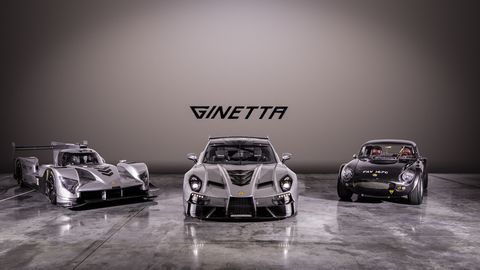
The LMP1-looks are not misleading. The suspension has adjustable pushrod activated twin wishbones front and rear, which are TIG welded from “seamless steel aero tubes.” The uprights are made from billet aluminum, with thick torsion bars completing the package.
With pretty much every component of this car being FIA-standard racing stuff, you’ll be happy to learn about such creature comforts as a camera with parking sensors, air-conditioning, heated screens, Bluetooth, wireless charging, and sat-nav. Just like in a Golf, really.
Now, all you need to decide is what sounds best: Ginetta’s 1965 G10, its current LMP1-contender, or the new road car?
By: Mate Petrany, February 27, 2019
For more cars, visit: https://www.roadandtrack.com/car-shows/geneva-auto-show/a26549649/ginettas-600hp-supercar-is-road-legal-lmp3-tech/
Source: https://www.roadandtrack.com/
McLaren 720S Spider Review

A car capable of putting a 200mph breeze across your bonce. Or perhaps more pertinently the roadster version of our favourite current supercar, McLaren’s 720S. Now, you know the score. Take supercar, remove roof, receive roadster. Only it’s never that simple because 700bhp supercars need to be stiff, and so in addition to the roof’s motors and panels, they need extra bracing and strengthening. End up weighing 150kg more.
You’re one step ahead of us, no doubt. McLaren’s dedication to a super-stiff carbon fibre tub instead of the aluminium monocoque used by almost all rivals means weight gain is kept to a minimum – just 49kg here – and strength isn’t sacrificed. That’s not to say both use identical Monocage II tubs. No, McLaren had to slightly alter the header rail to incorporate a central securing latch for the retracting roof.
OK, there’s a bit more to it, which has led to the 720S Spider’s chassis tub gaining an extra letter. This is now Monocage II-S. The changes mainly incorporate a new carbon rear section behind the seats (basically a frame for the roof to fold into) and alterations to the hinges and sealing as the door glass is now frameless.
The roof. Moved by electric motors rather than hydraulics, so it’s quieter. And it moves fast, too. Just 11 seconds to complete the sun vs rain routine. And at up to 31mph. McLaren is so proud of this lid, it’s applied for three patents on it.

The 720S coupe gained a reputation for habitability, thanks in no small part to excellent all-round visibility. This is an area roadsters typically perform badly in – somewhat ironic in a car designed to deliver maximum fresh air potential. But McLaren claims to have worked hard to keep the back deck low and that the glazed buttresses improve over-the shoulder visibility by literally some per cent.
Otherwise McLaren has copy/pasted coupe to roadster. Same hydraulic cross-linked variable dampers and active aero package (although your top speed is ‘only’ 202mph with the roof down, 212mph raised), and the 4.0-litre V8 twin turbo is carried over unchanged. But that’s still 710bhp and 568lb ft to do the shoving, so 0-62mph takes 2.8secs and 124mph is dusted in 7.9secs. The Coupe is obviously faster… but only by 0.1secs to 124mph. Basically nothing.
The biggest gain therefore is not the additional 49kg, but the fact McLaren charges £580 for each of those kilos. Yep, while the coupe starts at £208,600, base price for the Spider is £237,000. And like the coupe, most buyers upgrade to either Sport or Luxury specification (£246,990). And then use that as a jumping off point to greater things. Like the eleven carbon fibre option packs fitted to the car you see here that together add another £42,490, helping boost the total list price of this Luxury spec car to £321,900. Ouch.
By: Top Gear, February 27, 2019
For more cars, visit: https://www.topgear.com/car-reviews/mclaren/720s-spider
Source: https://www.topgear.com/
The 2020 Ferrari F8 Tributo Takes the Mid-Engined Sports Car Back to Its Roots
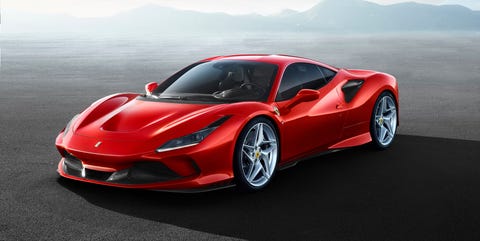
Maybe it’s because every new Ferrari debuts in a scorching coat of red paint, or, maybe it is Ferrari’s recent transition to gentle visual redesigns of its products that makes the new F8 Tributo appear, well, familiar. Is it that different from the 488GTB it replaces? Break out that zoom function in your browser or on your phone, look closer, and the F8 Tributo’s familiar visage isn’t quite what it seems.
The very literal name Ferrari has bestowed on its 488GTB replacement, F8 Tributo, is a hint as to what it’s up to here. This is a return to form, on an optics level, for Ferrari’s mid-engined eight-cylinder sports car, which experienced a hard break when the 458 Italia arrived in 2010. That car’s form valued function over beauty, and it had two single round taillights instead of four; when it evolved into the 488GTB, Ferrari really let its hair down and turbocharged its V-8, an act of autoerotic suffocation that exploded the engine’s power at the expense of the free-breathing noise we’d come to expect from Maranello’s eights. It still had two taillights.

The F8, then, is a true tributo—Italian for tribute, in case that wasn’t obvious—to mid-engined Ferraris gone by. There are, for example, four round taillights poking from its tail, as there have been on similar models going back to the 308 (and before that, the not-quite-Ferrari Dino cars). The V-8 remains turbocharged, but hey, so was the iconic F40’s V-8—and Ferrari promises it will deliver “an evocative soundtrack.” And the entire car is actually pretty, a descriptor we wouldn’t use for several Ferraris designed in-house in recent years, a period during which the Italian automaker’s longtime design partner, Pininfarina, was cut out of the process.
Ignore the red paint on the F8 pictured here, and you’ll notice several differences between it and the 488GTB. The headlights, for starters—Ferrari fans will think they’re the same as the 488’s, but what appears to be the darkened upper half of each one is actually a brake-cooling duct. Lighting comes courtesy of thin, horizontal LED strips positioned below these holes. Everything ahead of the windshield pulls forward to nearly a point around a new S-Duct, an aerodynamic pass-through from the lower bumper to a rearward-facing vent in the center of the hood that was borrowed from the hard-core 488 Pista and increases the F8’s overall downforce (relative to the 488GTB) by 15 percent on its own.

The 488’s already aggressive wedgelike shape has been whittled down further for the F8. Each wheel seems to yank the bodywork away from the two-seat central fuselage, and Ferrari’s stylists have balanced aerodynamic concerns against beauty better here than in any recent project. Nothing looks tacked on or strange. The rear spoiler flows out of the rear fenders seamlessly, while every gash and opening in the bodywork has been tastefully integrated into the body lines. Standout features include the Lexan rear window, which is louvered like that on the F40; the tight bubble-look roof; and the way the two elements merge and tuck in between the rear fenders and spoiler like a G-string.
By comparison, the interior represents a stylistic cold shower—in a good way. Like the 488GTB and the 458 before it, the F8’s cabin is businesslike and frill-free. Well, almost. Ferrari has installed its latest infotainment setup, which includes a pair of displays flanking the tachometer ahead of the driver and a small touchscreen readout placed ahead of the passenger that can keep them abreast of performance parameters such as speed and engine rpm; the little screen also can show navigation and audio information. As before, a row of push-button transmission controls lives on a thin console between the seats; the rest of the controls (save for the brake and gas pedals) live on or around the steering wheel.

A litany of new software additions help corral the F8’s burly V-8, and are controlled via the manettino drive-mode switch on that steering wheel. Ferrari’s latest Side Slip Angle Control traction- and stability-control program is present and allows even not-good drivers to appear heroic behind the wheel. (In our experience, the feature helps drivers steer and lay the power down with less finesse and without expensive consequences.) The Ferrari Dynamic Enhancer, which is an electronic program for managing drifts and not, ahem, the social boost equitable to purchasing a Ferrari, can now be used in the hard-core, otherwise hands-off Race drive mode.
By: Alexander Stoklosa, February 28, 2019
For more cars, visit: https://www.caranddriver.com/news/a26571313/ferrari-f8-tributo-photos-info/
Source: https://www.caranddriver.com/